
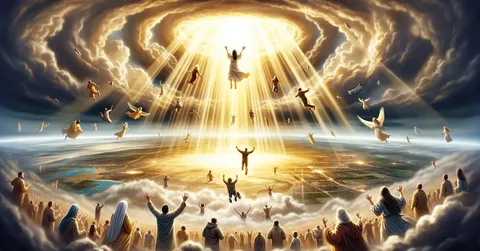
Well, this morning I want us to prepare for our study of the Book of Revelation – Lord willing, next week, we will sort of pick up where I left off in Revelation but do it in the morning. But before we do that, today I want to look at the issue that comes next.
At the Christian college I attended – some years before me, actually; it was legend by the time I came along – there was a male student who lived in constant fear the Rapture would come, and that he would be left behind. One night, his very unsympathetic roommates decided to play a cruel joke on this student – yeah, I know, it’s sad, isn’t it? After he had fallen asleep, they slipped out of their beds and then they remade their beds to look like they’d just sort of disappeared through the covers. They evacuated the entire floor of the dormitory, and they stationed three men in the hallway – one to shout, another to blow the trumpet, and a third to strike a stage device meant to simulate thunder. So, there it was – there was a shout, there was a trumpet, there was thunder, and then those men quickly ran to their hiding places. This student was awakened by the shout, the thunder, and the trumpet, and he looked around his room and his roommates were gone. He ran into the hall, and he saw no one; he threw open several doors, only to discover that everyone was gone – and he quickly concluded that his worst fears had been realized, the Rapture had happened, and he had been left behind. It was only after I moved to California that I discovered the name of one perpetrator involved in this prank – it was John MacArthur.
You know, there is a lot of confusion about the issue of the Rapture, and there’s also a lot of fear in the hearts of many believers about this event. Next week, Lord willing, as I said, we will pick up our study of Revelation, but today, I want us to study the mysterious event called the Rapture, because it is the next event on God’s prophetic timeline. I want to give you an overview of it – I’m not going to drill down into, for example, 1 Thessalonians 4, because we’re studying 1 Thessalonians on Sunday night, so we’ll get there and have a chance to look at that in detail – but I want to give you, instead, sort of an overview and sort of prepare you with the arguments for understanding when Christ returns, and then we’ll end by applying it – what is this supposed to mean for us?
So, let’s start, then, by looking at the word rapture – the word rapture comes from the Latin raptura; it’s the Latin word that was used to translate the Greek word harpazo in 1 Thessalonians 4:17. It’s the word that’s translated in our Bibles in the NAS as caught up – that word occurs some fourteen times in the New Testament; it literally means snatched away, suddenly removed. Just to give you the idea of how this word is used in other contexts, in John 10:28, Jesus says, “I give eternal life to them, and they will never perish, and no one” – here’s our word – “will snatch them out of My hand.” In Acts 8:39, it says, “When [Philip and the Ethiopian eunuch] came up out of the water, the Spirit of the Lord snatched Philip away” – there’s the word again. Harpazo means to suddenly remove or to snatch away – in the New Testament, it’s used of stealing or plundering, of removing something. It’s used of Paul’s being caught up to the third heaven, this very word is used – “I was caught up to the third heaven,”[SR1] he says – and it’s even used, in a figurative way, in Revelation 12 to describe Christ’s ascension; He was caught up into heaven.[SR2] So, the word rapture, then, means to seize and carry away, to remove from one place to another.
Now, as I begin, let me just make this point – every serious Bible student believes, based on 1 Thessalonians 4:17, that believers will be raptured; they will be caught up in the air. The key question is, when will that occur? Now, before we get to that question, let’s first consider why – why are there such different views on the timing of the Rapture? Well, it’s because of the exegetical dilemma that surrounds this issue – the exegetical dilemma; what is that exegetical dilemma? First of all, there are no clear statements of its timing – in other words, there’s no definitive passage that presents a clear, biblical position on the timing of the Rapture. It doesn’t say it’s going to happen before; it’s going to happen in the middle of the tribulation; it’s going to happen at the end of the tribulation – there’s no passage like that, and those who hold different positions admit this. For example, John Walvoord, who holds to a pre-tribulational position, which I will define in a moment, he says, “The fact is that neither post-tribulationalism, Christ returning for the church at the end of the tribulation, or pre-tribulationism; that is, Christ returning for the church before the tribulation, is an explicit teaching of scripture – the Bible does not, in so many words, state either.” And others have to admit that as well, regardless of their position.
So, without definitive scriptural statements, why are there several strongly held viewpoints? It is because there are apparent conflicts in what precedes the Rapture – the key word there is apparent. There are not conflicts, as we will see – but there are passages that seem to make conflicting statements on timing; let’s look at them. There are some New Testament passages that say Christ’s return will be sudden and unexpected; that is, it is imminent – Christ could return at any moment, and we should live constantly expecting that event. Here are some sample texts of many that argue for imminency; that is, that expect nothing else to happen before the Lord comes. Philippians 3:20, “Our citizenship is in heaven, from which we eagerly wait for a Savior, the Lord Jesus Christ” – that text implies that we are looking not for some other event on the world stage, we’re looking for Christ, that’s the next thing. In Philippians 4:5, “The Lord is near.” 1 Thessalonians 1:10, we “wait for His Son from heaven” – we don’t wait for the events of the tribulation, we don’t wait for the manifestation of the Antichrist, we “wait for His Son from heaven, whom He raised from the dead, that is Jesus, who rescues us from the wrath to come.” Titus 2:13, “In this present age,”[SR3] we live “looking for the blessed hope” – and what are we looking for? “The appearing of the glory of our great God and Savior, Jesus Christ.” James 5:8-9, “The coming of the Lord is near” – and then James uses this powerful image; he says, “Behold, the Judge is standing right at the door.” That’s a powerful image; it’s like Jesus has His hand on the doorknob and He’s about to twist it and open it and bolt in to receive us. Revelation 22:20, “He who testifies to these things says, ‘Yes, I am coming quickly,'” to which John replies, “Amen. Come, Lord Jesus.” To the first century readers of these texts, these passages clearly meant that they should stay alert, that they should expect that Christ could return on any day at any moment.
But there are also passages that say that Christ’s return will follow certain clear signs. In Matthew 24:3, the disciples ask, “‘What will be the sign of Your coming?'” And then Jesus lists a number of signs that will precede His coming – false Messiahs, “wars and rumors of wars,” famines, earthquakes, pestilences, persecution of true believers, spiritual defection of false believers, the gospel preached to the whole world. Now, you might look at that list and say, well yeah, but those are pretty generic – okay. He goes on – the great tribulation comes before; that’s a sign. The seven years comes first, the abomination of desolations in the temple comes first. Great cosmic signs in the sky – the sun darkened, the moon turned to blood. We can add one more that’s not in Matthew 24 – Paul adds, in 2 Thessalonians 2, the coming of Antichrist, the coming of the man of sin has to come first.[SR4]
So, how do we reconcile these apparent conflicts between imminent and signs? Well, there are proposed solutions to these apparent conflicts. Now, let me just say that there’s no view of Christ’s return that’s entirely without difficulties, but here’s how scholars have sought to reconcile the apparent conflicts. Some deny imminency and argue that the signs have not yet been fulfilled – these argue that Christ could not come at any time; instead, several signs have to happen first. Many who hold a mid-tribulation Rapture view; that is, they believe Jesus comes for His people in the middle of that future seven-year tribulation, take this view. Many who take a post-tribulational view; that is, that Jesus returns for His church at the end of the seven years of tribulation, take this view – in fact, some even speak of “the myth of imminency.” Advocates of the pre-wrath Rapture, which is just a variation of the mid-tribulation view, also often deny imminency. Now, that’s one approach – just say no, it’s not true that Jesus could come back at any moment; there have to be signs first – it doesn’t deal with a good portion of biblical text. A second approach redefines the signs to still believe in imminency; those who take this approach say either all the signs have been fulfilled – and the only way they can do that is by redefining them; you know, they have to say the great signs in the sky, the sun being darkened, the moon turned to blood, is something other than the sun being darkened and the moon turned to blood. Or, and this is a creative view of some, they say it’s unlikely but possible all the signs have been fulfilled, and because it’s possible, we should still live as if the return of Christ could happen today. The third solution is to affirm two stages of the Second Coming – one that’s imminent, and another that’s preceded by signs. This is the view of the pre-tribulation Rapture, which I will examine for you more in just a moment.
Now, growing out of that exegetical dilemma, then, there are three primary views of the timing of the Rapture. Three primary views; these three primary views regarding when Christ will gather believers to Himself are identified by their relationship to the future seven-year tribulation. First of all, there is a view called the pre-tribulation Rapture; that is, there are two stages of the Second Coming. The first stage, the Rapture of the church, occurs before the tribulation, and no signs need to be fulfilled before that happens – it’s imminent, it could happen any day, Christ comes to rapture His church to take them to Himself. The second stage, the Second Coming, comes seven years later at the end of the tribulation, and many signs have to be fulfilled before that event takes place.
The second primary view is a mid-tribulation Rapture – believers in Christ will be raptured at or near the middle of the tribulation, prior to the outpouring of God’s wrath in the last three-and-a-half years, which is called the Great Tribulation. Now, those who take this view argue that what happens in the first three-and-a-half years of the tribulation, that’s Satan’s wrath, that’s man’s wrath, but that’s not God’s wrath. Now, I have to, I want to treat all of these views with respect, but I have a hard time buying that after studying Revelation, because it’s clear throughout that God is pouring out His judgment and wrath on the world – but that’s their position. The pre-wrath view is a variation of this view – removing the church from the trumpet and bowl judgments which come at the end of the tribulation, which they define as the only expression of the wrath of God in those seven years. This view says Christ comes somewhere around the middle of the seven years, He will take believers back to heaven with Him until the end of the tribulation, when He will return with them in the Second Coming.
The third view is a post-tribulation Rapture, and that is that believers will be raptured into the air at the Second Coming at the end of the tribulation, then immediately descend with Christ back to the earth – so, it’s kind of an up-and-back, you know; you’re caught up into the air, and then immediately you return with Christ to this planet. If you want to study these three views more carefully, I preached two sermons on this issue back a number of years ago; you can access them online.
But I want us to now examine more closely the arguments for a pre-tribulation Rapture. The arguments for a pre-tribulation Rapture – now, let me, first of all, say that there are three key biblical texts on the Rapture from which several of these arguments come. Those three texts – if you want to study what the Bible says about the Rapture, study these three passages: John 14:1-3, 1 Corinthians 15:51-58, and 1 Thessalonians 4:13-18. We’ll look at all of those before we’re done this morning. The first argument for a pre-tribulation Rapture, that Jesus will return for His church before the seven-year tribulation period begins, is this – there are radical differences between the Second Coming that’s detailed in Matthew 24-25, and the Rapture which is laid out most fully in 1 Thessalonians 4. There are radical differences in how these two events are described; they cannot be the same event – in fact, there are ten radical differences that clearly distinguish the Rapture from the Second Coming. I don’t have time to go into each text and show you, but let me just encourage you, look at 1 Thessalonians 4 for the Rapture of the church, look at Matthew 24-25 for the Second Coming, and you’ll see every one of these ten differences clearly and starkly.
The first difference – in the Rapture, Christ comes in the air and returns to heaven; He doesn’t come to earth. In the Second coming, He returns to the earth, His feet land on the Mount of Olives, and He returns to dwell and to reign on the earth.
In the Rapture, He comes for His saints; in the Second Coming, He comes with His saints.
In the Rapture, Christ takes the saints back to heaven; in the Second Coming, He defeats His enemies and establishes His kingdom right here on earth.
In the Rapture, Christ gathers His own; in the Second Coming, the angels gather the elect.
In the Rapture, the resurrection is prominent; in the Second Coming, there is no mention of the resurrection.
In the Rapture, Christ comes to reward; in the Second Coming, to judge.
In the Rapture, believers are taken away from the earth; in the Second Coming, unbelievers are taken away from the earth.
In the Rapture, unbelievers remain on the earth; in the Second Coming, believers remain on the earth.
In the Rapture, believers receive glorified bodies; in the Second Coming, no one receives glorified bodies.
In the Rapture, there is no mention of the kingdom being established, but in the Second Coming, the kingdom is in fact established as a result of that event.
These are major differences – so, these two passages, 1 Thessalonians 4 and Matthew 24-25, are describing not one event, not one return, but rather two phases or stages of the return of Jesus Christ.
Let’s go to the second argument – Christ promises the church that it will be protected from God’s wrath. The tribulation is seven years of worldwide outpouring of God’s wrath, as we’ve seen in our study of the Book of Revelation – it is a time of God’s judgment on sinful humanity. But scripture says that believers will not face God’s wrath – generally, that’s true; Romans 5:9, “We shall be saved from the wrath of God through Him.” 1 Thessalonians 1:10, we “wait for His Son from heaven, … that is Jesus, who rescues us from the wrath” that’s coming. 1 Thessalonians 5:9, “God has not destined us for wrath, but for obtaining salvation through our Lord Jesus Christ.” So, in a general sense, we will never face God’s wrath – but scripture even promises that believers will be exempt from God’s wrath in the future seven-year tribulation period; turn with me to Revelation 3:10. This is in the letter to the church in Philadelphia – we looked at it at length when we studied this passage together – but look at verse 10, Revelation 3:10. “Because you have kept the word of My perseverance, I also will keep you from the hour of testing, that hour which is about to come upon the whole world, to test those who dwell on the earth.” Now, those who hold other positions say all this is, is a promise to protect the New Testament first-century believers from Roman persecution, persecution that was about to come. Well, there are several major problems with that – first of all, in the context of this book, and look at the next verse. The next verse is about Jesus coming, “I am coming quickly.” So, this, just in the context, must refer to the tribulation, the major tribulation that’s coming, the seven years. In addition, look again at verse 10 – notice that what Christ describes here will “come upon the whole world.” That phrase, the whole world, occurs two more times in Revelation – and in both cases, it means the entire world of unbelievers. Look as well, He says it will be “to test those,” and notice His expression, “who dwell on the earth.” That expression, to dwell on the earth, occurs often in Revelation, and it always refers to all living unbelievers on this planet.
So, verse 10, then, is referring to a worldwide time of wrath that God will bring upon the entire world of unbelievers – in other words, the tribulation, the seven years of tribulation. And notice Christ promises believers will be kept from that hour – the preposition that’s translated from is the Greek word ek. Some argue that that preposition means that Christ will protect them during or through the tribulation – in other words, we’re going to be here, and Christ is going to protect us through that time. And that is a legitimate definition of this word; it is used that way in some places. However, it’s also used often in the Septuagint and the New Testament meaning out from or away from – in other words, not that He will protect us through, that He will protect us from ever entering it. It’s used that way, for example, in 2 Corinthians 1:10 – God, Paul says, God “delivered us from … death,” ek death, He delivered us by keeping us from it, not by saving us through it. In 1 Thessalonians 1:10, Jesus “rescues us from,” ek, “the wrath to come.” It doesn’t mean He is going to preserve us through God’s eternal wrath, it means He is going to keep us entirely from it. Also, remember that during the tribulation, many people will come to faith, and most of them will be martyred – the majority of them, according to Revelation, will be martyred. There’s a crowd that shows up that can’t be numbered in heaven. So, think about this for a moment – Jesus must be promising here to keep believers from entering the tribulation, not protecting them through it, because the majority of them die after coming to Christ during the tribulation. So, Revelation 3:10, then, teaches that the church will be protected from, they will not be on earth during the tribulation and be subjected to the wrath of God.